

fires, fuels, forests
WHAT YOU NEED TO KNOW
What is Fire behavior?

Fire behavior is how a fire burns and spreads. It depends on weather, terrain, and fuels like grass, shrubs, and trees.
Hot, dry, and windy weather, steep slopes, and lots of vegetation make fires burn faster and hotter.
Embers are small burning pieces that can start new fires when they land. Hotter fires create more embers that can travel farther. When many embers blow at once, it’s called an ember storm, and fires can start very quickly.
Why does it matter?
Faster, hotter fires are harder to control and more likely to damage homes, property, and forests.
Understanding fire behavior helps people make better choices to reduce fuels and lower wildfire damage—helping protect homes and save lives!
 Fuels & Defensible Space
Fuels are anything that can burn, including live and dead plants, and things we build or use like homes, boats, and cars.
Understanding how fuels burn helps reduce the chance of fires near homes and large wildfires.
Defensible space focuses on the amount and spacing of plants and other fuels around a home.
-
Fires are less likely to start or spread when trees and plants are well spaced and well cared for.
-
Short grass and trimmed (limbed-up) trees keep flames low to the ground.
-
This helps protect homes and keeps firefighters safer.
Learn more about defensible space
and fire-wise landscaping.
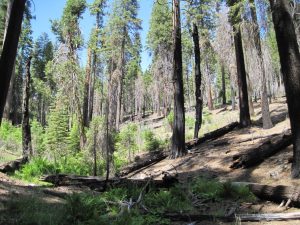 What Is a Healthy Forest?
A healthy forest is not just green or full of trees.
A healthy forest is resilient.
Resilient forests can recover after wildfire, drought, insects, or wind and still support wildlife, protect water and soil, and provide the places we love.
Fire is a natural part of Sierra forests. When forests are healthy, fire is less likely to become extreme—and communities are safer.
A healthy forest works with fire, not against it. Learn more